 Plateknow
 Take a picture of your food and a calorie app tells you the calories and macros. How far to trust that number depends on which part of it is measured and which part is an educated guess.

How an app counts calories from a picture
Every photo calorie app runs the same four stages. They differ in how good each stage is and how much of it they show you.
Segmentation — cutting the plate apart
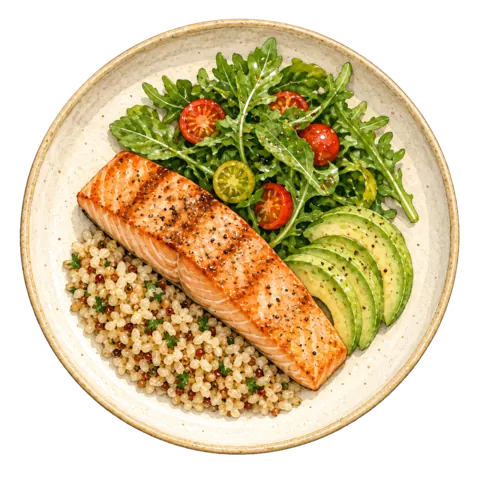
The photo is split into food regions: rice, salmon, avocado. This is now genuinely good when the foods sit visibly apart.
Identification — naming each region
“Grilled salmon” is easy. “Some kind of brown sauce” is not, and a sauce can carry more calories than the protein under it.
Portion estimation — the hard one
Grams are inferred from apparent size, with the plate as the reference. A photo has no depth, so nearly all of the error lives here.
Lookup — grams to calories
Once the app has “165 g of grilled salmon”, calories and macros come from a nutrition table, with little uncertainty left.
When a photo calorie counter is reliable
- Packaged and branded food, where the packet fixes the portion.
- Plates where the protein, starch and vegetables are not touching.
- Foods with a familiar shape: an egg, a slice of bread, a banana.
- Meals you eat often — correct one once, and a well-built app should stop getting it wrong.
- The trend across a week, even with some error on each meal.
Where photo calorie apps get it wrong
- Oil, butter and sauce. Invisible to a camera and calorie-dense — the same stir-fry changes a lot with the oil in the pan.
- Mixed dishes. A curry, a stew, a rice bowl with everything folded through has no visible boundaries to split.
- Depth. From above, a bowl shows its surface, not how deep the food goes.
- Food outside the training data. A model trained mostly on Western restaurant plates will misread a night-market meal or a convenience-store lunch box.
- Half-eaten plates. Photograph before you start.
Are photo calorie apps accurate?
It depends on the plate: a packet of crisps is nearly exact, a homemade curry is a guess with a photo attached — so be wary of any single accuracy percentage. What matters more is how quickly you can fix a wrong result. The accuracy page has the full answer.
How to choose the best photo calorie app
- Does it show how it read the plate? A bare number cannot tell you it mistook your chicken for tofu.
- How many taps to correct a portion? If fixing is slower than typing, the app has not solved the problem.
- Can you log fractional portions? Two thirds of a bowl is an everyday correction.
- What is free, exactly? “Free to download” is not a free tier — find how many AI scans you get without paying.
- Does it work with no sign-up? You should see a result before you are asked for an account.
Plateknow: take a picture of food, get calories and macros
Plateknow is an iPhone app that reads calories and macros from a photo and shows you how it read the plate. Every result card has a one-tap correction, portions adjust in fractions, and packaged food can be scanned by barcode or nutrition label. It works with no goal set, and the AI estimates are free with no account.
Not in your App Store yet · 50 test places
Not in your country yet? Take a test place.
An early build on your phone, and a direct line to the person writing the code.
50 places
Is there a free app that counts calories from a picture?
Yes. Plateknow’s AI estimates are free, with no account and no card — take a photo of the meal and it returns calories and macros. It is on the App Store for iPhone and on Google Play for Android.
Can a calorie counter app scan barcodes as well as photos?
Plateknow does both. For packaged food, scan the barcode or nutrition label — the numbers are the ones printed on the packet, and a product you have scanned once is recognised next time. Photos are for the food with no barcode.
Can I count calories from a picture online, without an app?
Plateknow works in its iPhone app rather than on this website: take the photo in the app and the result card shows calories and macros.
Do photo calorie apps work for Indian food and other non-Western meals?
Only as well as the plates the model was trained on. Test any app on the meals you actually eat before you rely on it.